Features
Part of Scrolling habits and attention: a practical guide
Testing a scrolling habit change against the evidence
Scrolling habit experiment example: follow a fictional editor who tests notification batching, direct feed entry, stopping cues, bedtime rules, and outcomes.
What to take away
- This fictional case begins with one outcomeprotecting two focused editing blocks.
- The experiment changes alerts and entry routes while keeping necessary messages available.
- Screen time is recorded alongside task completion, sleep, mood, and unplanned openings.
- Results over two weeks can support a local decision but not a claim about every user.
- The plan includes a rollback if urgent communication is missed.
Jordan Lee and Cedar Review are fictional. Jordan edits a small arts newsletter from home and uses a phone for sources, contributor messages, calendar alerts, and social promotion.
Jordan's problem is not the daily total. It is that promotional alerts and message previews trigger feed checks during two 50-minute morning editing blocks. After each check, Jordan rereads several sentences to find the place again. That framing dodges the metric trap: the outcome is completed blocks, not minutes.
Baseline design
For five workdays, Jordan changes nothing and records:
Baseline: five workdays
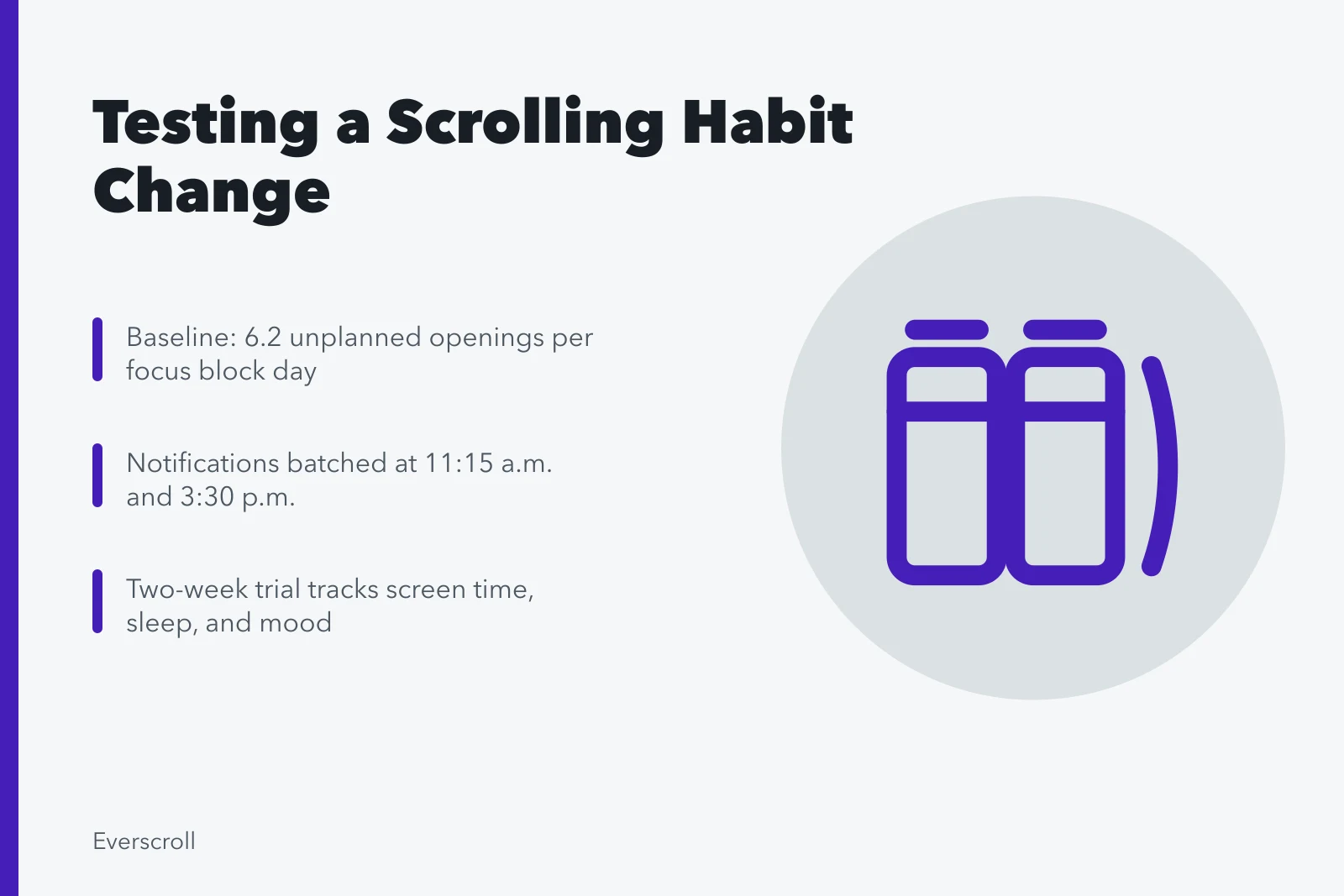
- 6.2unplanned openings per day
- 0.8 of 2completed 50-minute blocks
- 47morning feed minutes
- 4.1post-block strain, 1 to 5
| Measure | Baseline average |
|---|---|
| Unplanned phone openings during focus blocks | 6.2 per day |
| Completed 50-minute blocks | 0.8 of 2 |
| Morning feed minutes | 47 |
| Urgent messages missed | 0 |
| Bedtime after midnight | 3 of 5 nights |
| Self-rated post-block strain, 1 to 5 | 4.1 |
The records show that most openings begin with three app categories: promotional social alerts, group-chat reactions, and news recommendations. Contributor calls are rare and need to remain audible. The log is doing what the habit-loop model predicts: cues, not willpower, explain the openings.
Evidence used for the notification change
A PubMed-indexed field experiment on communication notifications, performance, and strain assigned 247 participants to conditions including disabling notifications for one day.
The abstract reports benefits from fewer notification interruptions for performance and strain, moderated by fear of missing out and responsiveness pressure. Jordan uses this to test, not to promise the same effect in editorial work.
The two-week intervention
Notification batch
Jordan allows calls from contributors and family. Direct messages arrive silently, while reactions, recommendations, promotional alerts, and news prompts are off. A calendar reminder opens the message inbox at 11:15 a.m. and 3:30 p.m.
Five changes Jordan tests
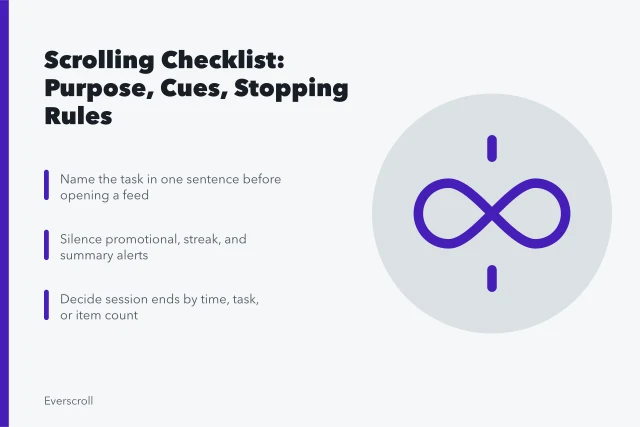
- Batch notifications, calls still ring
- Enter jobs by bookmark, not feed
- Write task and endpoint on card
- Type one resumption line per interruption
- Feeds close at 10:30 p.m.
Direct entry
Browser bookmarks lead to the newsletter's publisher dashboard and two source lists. Jordan does not enter these jobs through a social home feed.
Visible stop
Before each necessary promotion session, Jordan writes the task and endpoint on a card: "Publish link, answer named replies, record issues, close after 15 minutes." The phone returns to a shelf after the timer.
Resumption note
At any permitted interruption, Jordan types one line in the draft: "Next: verify the date in paragraph four." This makes the return concrete.
Evening boundary
News and social feeds close at 10:30 p.m. Calls from selected contacts still ring. The phone charges across the room, and a separate clock handles the alarm.
Why well-being is not reduced to minutes
A PubMed record for an umbrella review of social media use and well-being says 27 reviews published through August 2021 reached differing results and examines gaps behind that disagreement. Jordan therefore avoids claiming that fewer minutes must improve well-being. The experiment measures the outcomes Jordan named.
Fictional results
These numbers are invented for this worked example.
Baseline vs week 2
Baseline
- Unplanned openings
- 6.2
- Completed blocks
- 0.8 of 2
- Morning feed minutes
- 47
- Urgent missed
- 0
- Nights after midnight
- 3 of 5
- Post-block strain
- 4.1
Week 2
- Unplanned openings
- 1.4
- Completed blocks
- 1.8 of 2
- Morning feed minutes
- 18
- Urgent missed
- 0
- Nights after midnight
- 1 of 5
- Post-block strain
- 2.6
Baseline
- Unplanned phone openings during focus blocks
- 6.2
- Completed 50-minute blocks
- 0.8
- Morning feed minutes
- 47
- Urgent messages missed
- 0
- Bedtime after midnight
- 3 of 5
- Self-rated post-block strain, 1 to 5
- 4.1
Week 2
- Unplanned phone openings during focus blocks
- 1.4 per day
- Completed 50-minute blocks
- 1.8 of 2
- Morning feed minutes
- 18
- Urgent messages missed
- 0
- Bedtime after midnight
- 1 of 5 nights
- Self-rated post-block strain, 1 to 5
- 2.6
Jordan also logs one problem. A contributor sends a time-sensitive direct message rather than calling, and Jordan sees it 42 minutes later. The issue is inconvenient but does not affect publication. The miss restates the comparison's first row: emergency notices need direct alerts, not ranked delivery.
Revision after the test
The newsletter's contributor instructions now say to call for same-hour issues and use direct messages for anything that can wait until the next check. Jordan adds one message review between the two focus blocks on publication day only.
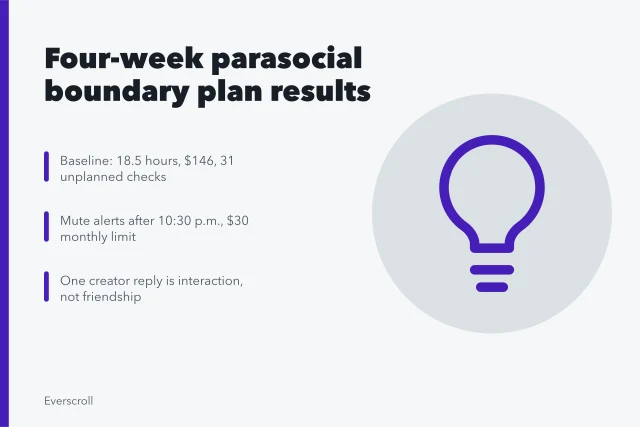
The promotion card stays because it prevents the publishing task from turning into general browsing. The bedtime rule stays, but Jordan treats the better sleep timing as an observation, not proof that the phone was the only cause. The four-week boundary case ends the same way: coincided, continued, review date set.
Limits of the case
The intervention is not blinded, the sample is one fictional person, and work volume may differ between weeks. Self-rated strain is subjective. The baseline is short. A breaking news event could change feed use, and a caregiver or on-call worker might need different notification rules.
The defensible conclusion is narrow: under the fictional conditions, the revised alert and entry setup coincided with fewer unplanned openings and more completed editing blocks without a missed urgent call.
A reusable experiment template
- Define one unwanted consequence.
- Record a normal baseline.
- Identify the main cues and routes.
- Change no more than two or three features.
- Preserve genuine emergency access.
- Measure the named outcome.
- Record side effects and exceptions.
- Keep, revise, or roll back based on results.
Common questions
Is Jordan real?
No. The person, publication, measurements, and results are fictional.
Why did Jordan keep direct messages?
They support necessary work. The plan changed their timing and urgency signal rather than removing communication.
Does the experiment prove notifications cause strain?
No. It tests a local change while acknowledging workload, expectation, and other possible influences.
Why include bedtime in a work-focus experiment?
It was a secondary observation tied to the same alert environment. The primary outcome remained completed editing blocks.
What would trigger rollback?
A missed urgent call or repeated failure in the contributor escalation route would require immediate revision.
How long should a real test run?
Long enough to include normal high- and low-demand days, with a baseline and a review date set in advance.