Maintenance
A working brief on social media slang: the 2027 view
A guide to writing social media slang entries that age well: the fields that matter, the status ladder, and the four things to leave out entirely.
Most online glossaries are wrong within a year. The cause is structural, not laziness. They record a meaning and nothing else.
Meaning moves fastest in an entry and helps least on its own. A reader who meets the word in the wild needs to know who says it, in what register, and what it signals about the speaker.
This page is a specification for a glossary entry that ages well, and a short list of what to leave out.
What to take away
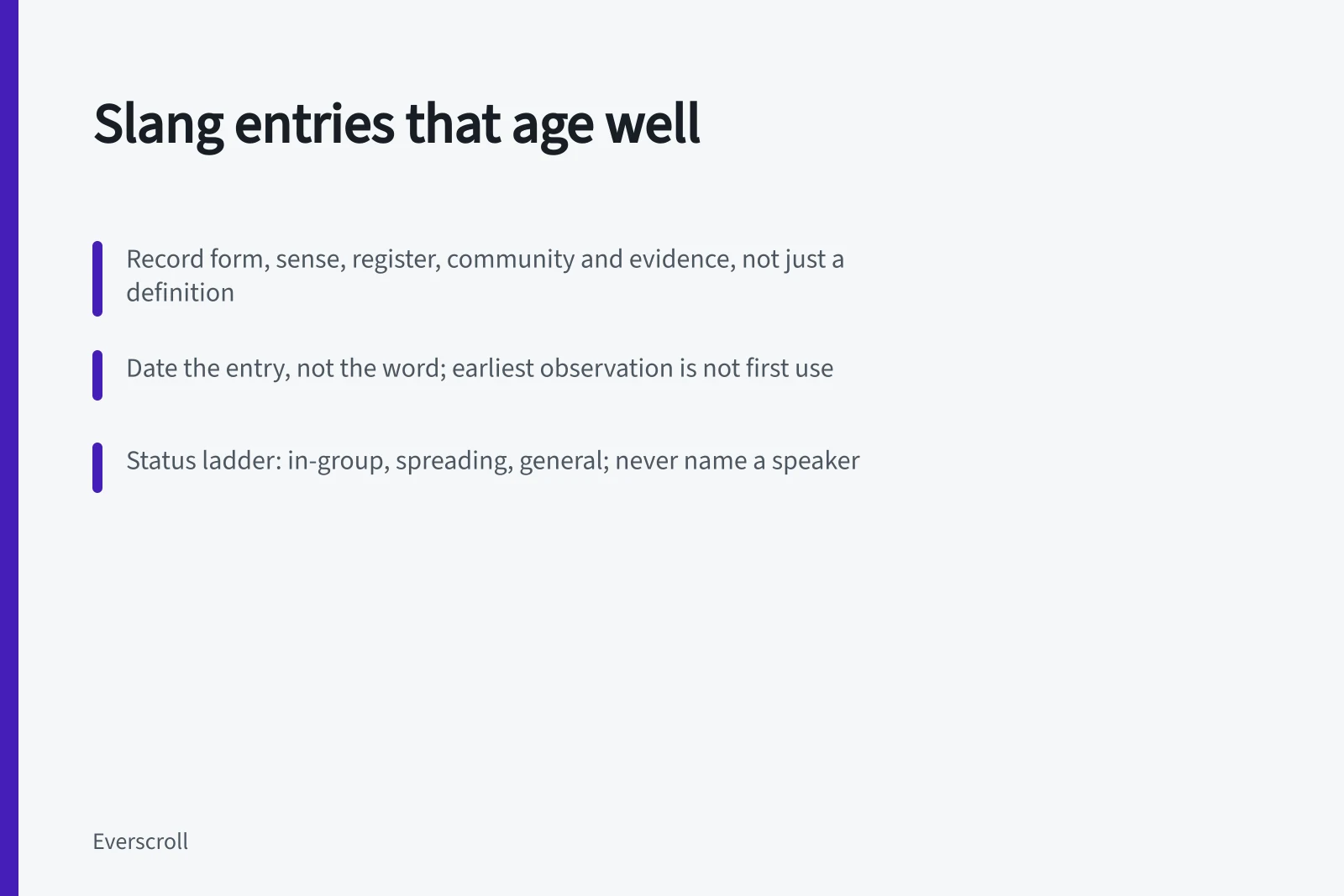
- An entry that records only a definition is a snapshot. An entry that records form, sense, register, community and evidence is a record, and a record can be updated instead of replaced.
- Date the entry, not the word. You know when you checked. You do not know when the word started.
- Mark the sense you are describing as one sense, and expect it to be one of several.
- Never write an entry that identifies who said it. The word is the subject; the speaker is not.
The fields
| Field | What it holds | Why it earns its place |
|---|---|---|
| Form | The spelling or spellings, including the deliberate misspellings | Variants are the main obstacle to finding earlier uses |
| Part of speech and pattern | Noun, verb, intensifier, discourse marker, and what it attaches to | Function shifts before meaning does, so this is the early warning |
| Sense | One sense, stated plainly, with the sense number if you know of others | A single definition that tries to cover every use covers none |
| Register | Casual, ironic, hostile, affectionate, technical | This is the field readers actually need and the one most often missing |
| Community | The group in whose speech you observed it, described generically | Meaning is community-relative; without this the entry is not falsifiable |
| Evidence | Where you saw it and when you checked, with no author identified | Turns an assertion into something a later editor can re-check |
| Status | Live, spreading, mainstream, mocked, dead, revived | The field that lets a stale entry announce its own staleness |
| Confusables | Terms it gets mistaken for | Most reader errors are collisions, not gaps |
The two fields that do the most work are register and status, and they are the two that standard glossaries omit. Register is what tells a reader whether using the word will read as fluent or as a costume. Status is what tells the next editor whether to touch the entry at all.
Fields for a Slang Entry
- Formspellings and deliberate misspellings
- Part of speech and pattern
- Senseone plain definition
- Registercasual, ironic, hostile, affectionate
- Communitywhere you observed it
- Evidencewhere and when you checked
- Statuslive, spreading, mainstream, mocked, dead
- Confusablesterms it gets mistaken for
Writing the sense line
A sense line should survive being read by someone who has never encountered the term. That means class first, then difference: say what kind of thing the word does, then what distinguishes it from the nearest neighbor. The practice is old and well described under lexicography, and none of it changes because the corpus is online.
Writing a Sense Line
- State the class of thing the word does
- State what distinguishes it from nearest neighbor
- Avoid defining by example only
- Avoid defining by synonym
- Avoid defining ironic use as literal
Three habits to avoid:
- Defining by example only. An example shows one use; it does not bound the sense, and readers over-generalize from it.
- Defining by synonym. A synonym moves the problem to another word whose register is different, which is exactly the information the reader needed.
- Defining the ironic use as the literal one. When the usual use is ironic, that is the sense, and the literal reading belongs in a note.
The status ladder
Terms move along a predictable path, and status is worth recording as a position on it rather than as a judgment. The path is not special to this medium: it is the ordinary career of a neologism, compressed.
The Status Ladder
- 1In-group used inside one community
- 2Spreading appears in neighboring communities
- 3General understood broadly, community moves on
- 4Institutional appears in ads and headlines
- 5Mocked marks the speaker as behind
- 6Dormant unused, not forgotten, revivable
A term at stage four is not dead, but its usable register has collapsed to one option, and an entry that does not say so will mislead everyone who consults it. The reason the ladder exists at all, and why membership signaling drives it, is set out under social media slang.
What to leave out
No first use. You have an earliest observation. It is a fact about your search, not about the word. Record it as such, in the evidence field, and never in a sentence beginning with the word "coined".
What to Leave Out
- No first userecord earliest observation as evidence
- No named speakerdo not attach a person
- No usage countscounts measure a corpus
- No pronunciation guesseswritten terms often unsettled
No named speaker. Quoting one identifiable person as the source of a word attaches an ordinary person to a permanent public record for something they did casually. The general risk is set out under critiques of social media; the editorial rule is simpler, which is that the entry does not need it.
No usage counts. Any figure you could produce measures a corpus, not a language, and the corpus is built out of whatever happened to be public and machine-readable. What that does to a count is set out under internet culture archives.
No pronunciation guesses. Written terms often have no settled pronunciation, and inventing one gives readers a way to be wrong out loud.
Reviewing the glossary
Set a review interval and check the status field first. Most entries need nothing. The ones that need work announce themselves: an entry marked spreading that you have not seen in months has probably moved to general or gone dormant, and an entry marked live that now appears in advertising has moved to institutional.
When a sense has genuinely changed, add a sense instead of editing the old one. Keep the old one with its date.
A glossary that overwrites its history cannot show drift. Drift is the only reliably interesting thing about a term. The same argument for retaining prior states applies to every dated record here, as platform timelines sets out at length.
Common questions
How many senses should one entry carry?
As many as you have observed, each with its own evidence line. Merging them into one broad definition looks tidier and is less useful.
What if I only ever see the term in one community?
Then say so in the community field and mark the status as in-group. An entry that admits a narrow observation base is more useful than one that implies a general survey nobody did.
Is it worth recording terms that are already dead?
Yes, if you can date your observation. Dead terms are what a later reader will be looking up, since living ones can be asked about directly.
Should the glossary be public?
That is a separate decision, and the honest answer is that publishing raises the exposure of the community you observed. If the entries are generic enough that no community is identifiable, publishing costs little. If they are not, keep it private and publish the method.