Features
How Washington, D.C. shapes US platform rules through the FTC and FCC
Ever scroll through US platform rules and you land in Washington, D.C., where FTC rulemaking and FCC broadband policy decide what creators can post and reach.
What to take away
- Every time you ever scroll past a sponsored post or a blocked video, the rule behind it likely started in a Washington, D.C. agency, not a state capitol.
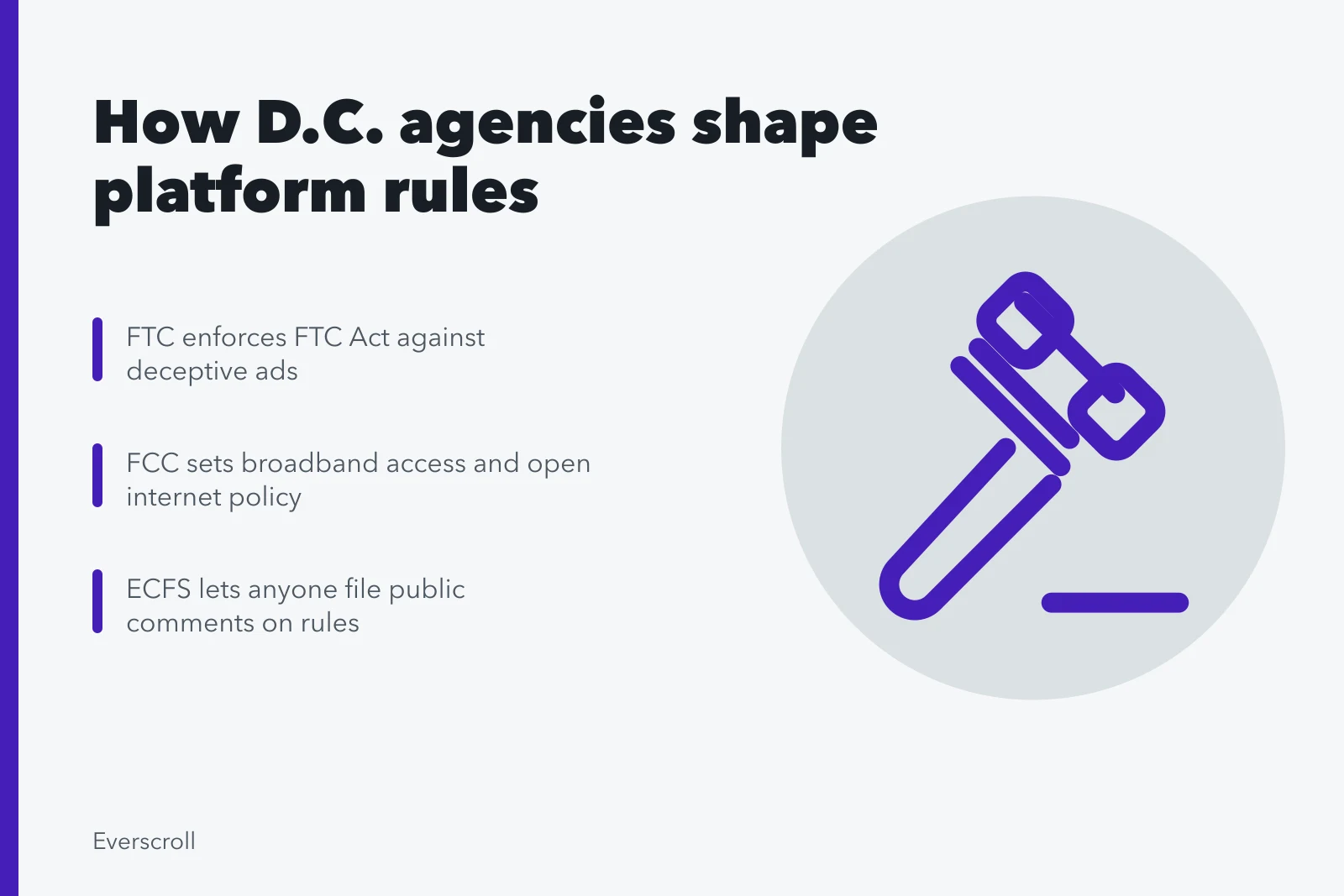
- The FTC writes and enforces endorsement and disclosure rules that apply to creator posts, under its FTC Act authority to stop deceptive advertising.
- The FCC sets broadband access and open internet policy, which shapes whether your audience can load your videos at all.
- The FCC's ECFS comment system lets anyone file a public comment on open proceedings, and those comments become part of the official record.
- The most active FCC proceedings change often, so creators and community operators should check the list before assuming a rule is settled.
- Neither agency regulates speech directly, but their output reaches creators through disclosure duties, ad rules, access rules, and platform compliance.
How Washington, D.C. became the center of US platform rulemaking
Washington, D.C. is not a state. It is a federal district, and that matters for internet policy. Congress sits there, and so do the agencies it creates. The FTC and FCC both have headquarters in the city, and both write rules that apply across all fifty states.
That arrangement is unusual. California can pass its own privacy law, and New York can pass its own ad rules. But only a federal agency in Washington can set a national floor for endorsement disclosure or broadband access. When those rules change, they change everywhere at once.
For creators, the practical effect is that a single rulemaking can reach every platform account in the country. A disclosure format adopted in a D.C. hearing room becomes the format you use in a sponsored video, no matter where you live.
The city's role grew as the internet became commercial. Early online services raised questions about advertising, access, and liability that no single state could answer alone. Congress responded by giving agencies authority, and those agencies built their processes in Washington.
Two agencies matter most for platform rules. The FTC handles advertising and disclosure. The FCC handles access and the pipes that carry content. Their work overlaps at the edges, but each has a distinct lane.
FTC rulemaking and endorsement rules developed in the capital
The FTC is an independent agency. It enforces a broad statute, the FTC Act, which bars unfair or deceptive acts or practices in commerce. That authority is the legal basis for most federal advertising and endorsement rules.
The FTC rulemaking process has two main tracks. One is formal rulemaking under specific statutes, which produces binding rules with the force of law. The other is guidance and enforcement, where the agency publishes guides and then brings cases against companies that ignore them.
For creators, the endorsement guides are the most visible output. They say that a material connection between an endorser and a brand must be disclosed clearly and conspicuously. A free product, a commission link, or a paid post all count.
The guides are not statutes, but they shape behavior. The agency can bring an enforcement action against a brand or an endorser who hides a material connection. Penalties can include money and required compliance programs.
Formal rulemaking under the FTC's procedures follows a set sequence. The agency publishes a notice, takes comments, and then issues a final rule. That final rule can be challenged in court, but it applies nationwide while it stands.
A creator who wants to understand the boundary between a guide and a rule should read the agency's own description of the process. The FTC's rulemaking process lays out how the agency proposes, reviews, and finalizes rules, and how the public can weigh in at each stage.
The FTC's reach extends beyond ads. Its authority covers deceptive claims about a product's performance, fake reviews, and some data practices. Creators who run affiliate operations or review channels fall inside that scope.
One limit is worth naming. The FTC does not police political speech or most editorial content. Its focus is commercial speech, which is why disclosure rules attach to paid relationships rather than opinions.
FCC broadband policy and what it means for creator reach
The FCC regulates interstate communications by wire and radio. That includes broadband, the service most creators depend on to upload and most audiences depend on to watch. The commission's decisions set the conditions under which internet access is sold and delivered.
Broadband policy covers several things at once. It covers how service is classified, what speeds count as broadband, how providers may treat traffic, and how subsidies reach unserved areas. Each of those choices affects whether a viewer can load a video.
The agency's structure is set by statute. An overview of the FCC explains that it is an independent agency overseen by Congress, with five commissioners and a chair who sets the agenda. That structure shapes how fast rules move and whose priorities prevail.
For creators, the most direct link is reach. If a provider can block or slow a service, or if a rural area lacks adequate service, the audience for a video shrinks. Broadband policy is therefore audience policy, even when it looks like infrastructure policy.
Open internet rules are the clearest example. When the commission adopts rules against blocking, throttling, and paid prioritization, platforms and creators get a more predictable delivery path. When those rules are narrowed, providers gain more discretion.
Subsidies matter too. Programs that expand broadband buildout in rural and low-income areas add potential viewers. A creator with a national audience has a stake in whether those areas get service.
Access policy also touches devices and spectrum. New wireless bands can change how people watch short video on phones. The commission's decisions on those bands can shift mobile viewing habits over time.
The FCC does not decide what content is allowed on a platform. That is a common confusion. The agency regulates transmission, not editorial choices, though its access rules can affect which services are practical to use. The FCC rulemaking process shows how those access decisions move from proposal to final rule.
The ECFS comment system and public input on internet rules
The FCC takes public input through the Electronic Comment Filing System, known as ECFS. It is the official portal for comments on open proceedings. Anyone can file, including creators, community operators, and small businesses.
ECFS is not a petition site. It is a docket system. When the commission opens a proceeding, it assigns a number, and every comment filed under that number becomes part of the record the agency must consider.
Filing a comment is straightforward. The steps below reflect how the system works in practice.
- Find the proceeding you care about by its docket number or subject on the ECFS comment system.
- Open the proceeding and read the notice to learn the specific questions the agency is asking.
- Prepare a short comment that states who you are and how the rule would affect your work.
- File the comment through ECFS before the deadline, and keep the confirmation for your records.
- Check the docket later to read replies and see whether the agency changed its proposal.
Comment quality matters more than length. A comment that describes a concrete effect, such as lost revenue or blocked access, gives the agency something it can use. A form letter adds volume but little detail.
Deadlines are strict. Comments filed after the window closes usually do not enter the record. Reply comments come later and respond to what others filed.
The record also matters in court. If an agency ignores substantial comments, a challenger can argue the decision was arbitrary. That is why organized comment campaigns can influence outcomes even when they do not change the final rule.
For creators, ECFS is the most direct way to participate in internet regulation without hiring a lobbyist. It is free, public, and searchable. It also pairs well with the practical guidance on how to set parasocial boundaries around the platforms and personalities that shape your audience.
Most active proceedings shaping platform and access debates
The FCC maintains a list of its most active proceedings. The list changes as new notices open and old ones close. It is the fastest way to see where the commission is currently putting its attention.
Checking that list is useful for two reasons. It shows which rules are still in play, and it shows which comment windows are open. A creator who wants to file a comment should start there.
Active proceedings often cluster around a few themes. Broadband deployment and subsidies appear regularly. Spectrum allocation shows up when new wireless uses are proposed. Open internet and access questions return whenever the commission's majority changes.
Platform-adjacent issues also appear. The commission has looked at questions involving online services, though its authority over content remains limited. Debates about access, interconnection, and service quality can still affect how platforms perform for users.
Because the list is updated, no single snapshot stays accurate for long. The table below shows the kinds of proceedings that commonly appear and what each means for creators. Treat it as a map of categories, not a fixed docket.
| Type of proceeding | What it covers | Why creators watch it |
|---|---|---|
| Broadband deployment | Subsidies and buildout in unserved areas | More viewers in rural and low-income markets |
| Open internet | Blocking, throttling, paid prioritization | Predictable delivery for video and live streams |
| Spectrum | Wireless bands for mobile service | How audiences watch short video on phones |
| Interconnection | How networks exchange traffic | Whether a platform loads quickly for users |
| Data and privacy | Consumer data practices in communications | Compliance duties for community operators |
A worked example shows how this plays out. Suppose a creator runs a membership community with live video. If an open internet proceeding proposes rules on paid prioritization, that creator can file a comment describing what slow lanes would do to live attendance and revenue.
The comment enters the record, and if the agency adopts rules, the creator's delivery path becomes more predictable. If the agency declines, the creator may need to plan around variable quality. Either way, the proceeding in Washington changed the operating environment.
What each agency's output means for creators and communities
The FTC and FCC produce different kinds of rules, and creators should track them separately. FTC output usually arrives as disclosure duties and advertising standards. FCC output usually arrives as access conditions and infrastructure decisions.
The FTC side is about what you say and how you say it. If you accept payment or free products, you must disclose it. If you make claims about results, you must be able to support them. Those duties apply whether you run a solo channel or a small team.
The FCC side is about whether your audience can reach you. Broadband rules, spectrum decisions, and subsidy programs determine how many people can watch and how reliably. A creator with a loyal but rural audience feels those decisions directly.
Community operators face both sets of rules. A forum that sells ads or sponsorships falls under advertising standards. A community that depends on video calls or live events depends on broadband conditions.
Compliance is not only a legal question. It is an operating question. A creator who builds a disclosure habit and tracks access conditions can avoid sudden disruptions. That is part of learning how to online identity and self-presentation in a way that holds up over time.
It also connects to the wider online identity and self-presentation checklist, where revenue, platform risk, and business structure are treated together. Rules from Washington are one input into that structure, not a separate topic.
Platforms enforce their own policies on top of federal requirements, and those policies can change faster than agency rules. A creator who understands both layers is less likely to be surprised.
Many of the pressures creators feel, unstable reach, income swings, and workload, have policy dimensions. The online identity and self-presentation comparison that show up in surveys and forums are partly shaped by access rules and disclosure duties set in the capital.
A practical checklist can help a creator or community operator stay current.
- Check the FTC's rulemaking page once a quarter for proposed changes to endorsement or advertising rules.
- Check the FCC's most active proceedings list before assuming an access rule is final.
- File a comment in ECFS when a proceeding would affect your audience or delivery.
- Keep records of sponsorships, free products, and affiliate links for disclosure purposes.
- Review platform policies separately from federal rules, since they change on different schedules.
- Note which broadband programs serve your audience's region, especially rural areas.
- Revisit your revenue plan when a major rule is adopted or struck down.
Washington, D.C. agency locations matter for anyone who wants to meet regulators in person. The FTC and FCC headquarters are in the city, and both hold public meetings and workshops. Those events are open to the public and often streamed.
Attending or watching a meeting is a low-cost way to learn how the agencies think. The questions commissioners ask reveal what they consider important. That context helps when you decide whether to file a comment.
State laws still matter alongside federal rules. California's privacy laws and other state statutes add duties for creators who collect data. But the federal framework set in Washington often sets the baseline that states build on.
Section 230 of the Communications Decency Act is a separate framework. It shapes platform liability for user content, and it is set by Congress rather than the agencies. Creators should understand it as a distinct layer from FTC and FCC rules.
The IRS also enters the picture. Income from brand deals and platform payouts is taxable, and self-employment tax applies. That is a tax question, not a platform rule, but it belongs in the same operating plan.
Looking ahead, the balance between the two agencies will keep shifting. New commissions change priorities, and courts review major rules. Creators who follow the process rather than a single outcome will be better prepared for whichever direction the next cycle takes.
Common questions
Does the FTC regulate what creators post? Only commercial speech. The agency enforces disclosure and advertising rules, not opinions or editorial content. Paid relationships and deceptive claims are the focus.
Can I file a comment in ECFS as an individual? Yes. ECFS is open to anyone, and individual comments enter the official record. A short, specific comment is more useful than a form letter.
Does the FCC decide which apps platforms must carry? No. The FCC regulates transmission and access, not editorial choices. It does not tell platforms which content to host.
How often do FCC proceedings change? The most active list changes as notices open and close. Check it before relying on any summary of current rules.
Do state laws override FTC and FCC rules? Not exactly. Federal rules often set a floor, and states can add requirements in areas like privacy. The interaction varies by issue.
Where are the agencies located in Washington, D.C.? Both the FTC and FCC have headquarters in the city and hold public meetings there. Their websites list addresses and streaming options.