Guides
Online News Act vs Platform Deals: What Canadian Publishers Face
Canada's Online News Act lets some publishers bargain, but a one-person site with no audience is locked out of CRTC arbitration and platform deals.
What to take away
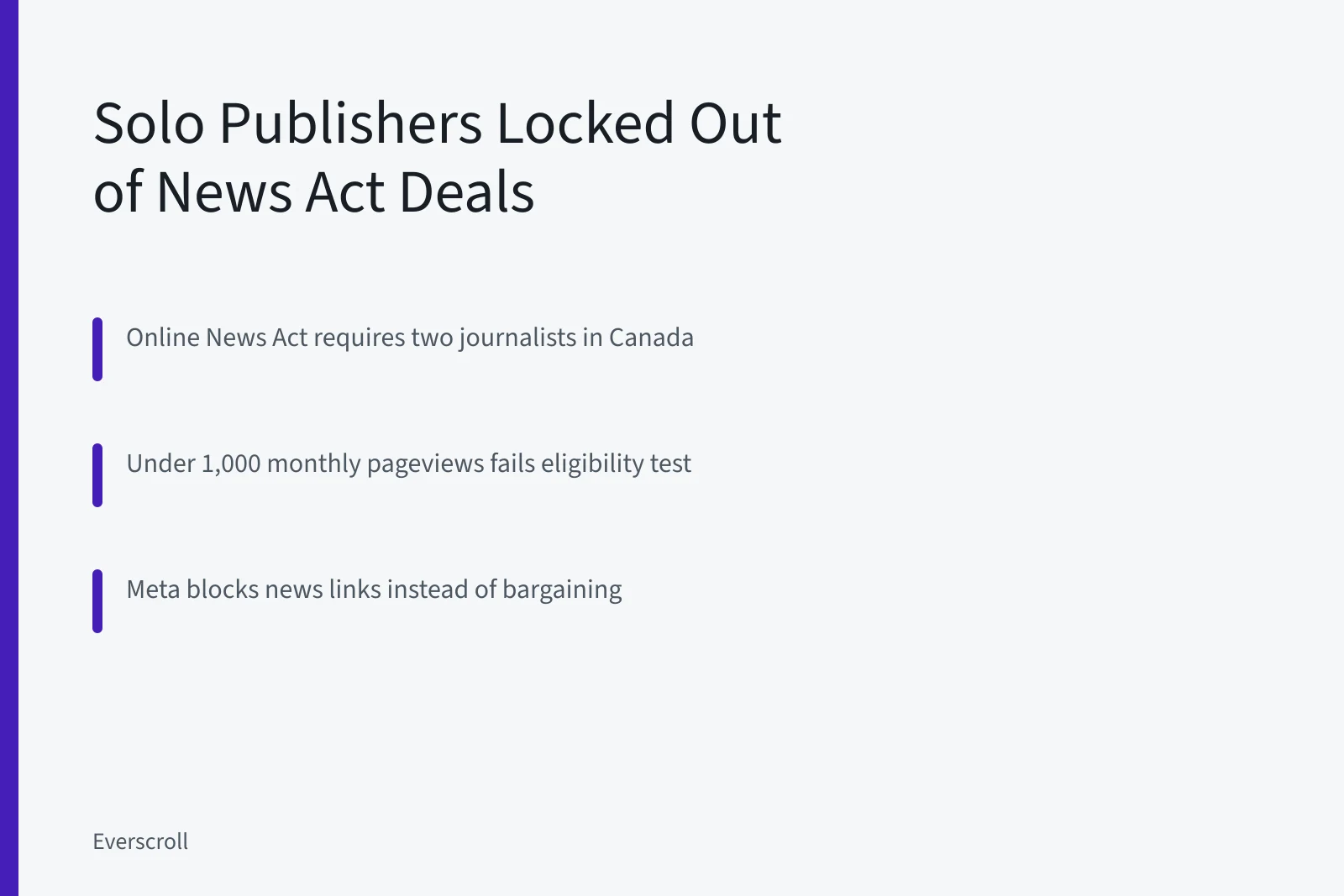
- A one-person Canadian news site with no budget and under 1,000 monthly pageviews cannot meet the Online News Act's two-journalist threshold. Direct platform deals and CRTC arbitration are ruled out until that changes.
- Google has a payment deal with Canadian news businesses. Meta blocks news links instead of bargaining, and the CRTC oversees arbitration for eligible businesses.
- A solo publisher can still build an audience through email, RSS, and direct search. Those channels do not depend on a platform deal.
- The free workaround stops paying around 30,000 to 50,000 monthly pageviews, an illustrative range. After that, paid help and a second journalist become the cheaper path.
What the constraint removes
A Canadian publisher with zero annual revenue, one unpaid owner-operator, and fewer than 1,000 monthly pageviews faces a hard limit. The Online News Act requires eligible news businesses to generally employ at least two journalists in Canada. A solo operation fails that test. This constraint rules out any direct negotiation with Google or Meta under the Act. It also rules out CRTC news arbitration, because only eligible businesses can trigger that process.
Bill C-18 platform payments are not a menu you can order from alone. Google struck a deal to pay Canadian news businesses through a collective, but that collective decides distribution. Meta has blocked news links in Canada since August 2023 and has not returned to the table. Check the Canadian Heritage overview for eligibility details.
The US has no direct equivalent to Bill C-18. Platforms there enjoy broad immunity under Section 230 explained, while Canada's law forces a different kind of liability. That contrast matters because a Canadian solo publisher cannot import a US bargaining model.
What still works
Even under this limit, a solo publisher can still publish original reporting on a domain they control. Email newsletters, RSS feeds, and direct search traffic bypass platform news blocks. A site with 500 loyal readers can still influence a niche, even if Google and Meta ignore it. Use the Online News Act as a public relations hook, not as a revenue source. When a platform blocks your links, write about it. That story can attract readers who care about Canadian media policy.
- Register a custom domain and set up an email list.
- Publish two original stories per week on a niche topic.
- Submit the site to Google News and Bing News manually.
- Document each platform block with screenshots and dates.
A solo site can also republish through a Creative Commons licence to reach larger audiences. That does not create a platform deal, but it can attract inbound links and search visibility. A few dozen backlinks from other Canadian outlets can push a story onto page one.
Canada's approach differs from Washington, D.C. shapes US platform rules through the FTC and FCC. The CRTC is the Canadian counterpart, but its power applies only to eligible news businesses. A solo publisher cannot file a complaint, but public attention still matters.
Compromises worth making
Some compromises are worth making now, as long as they cost little money and less than five hours a week.
| Compromise | What it gets you | Measurable limit |
|---|---|---|
| Write for a larger eligible outlet as a freelancer | Byline exposure and a relationship with a qualifying newsroom | Accept only if it costs under 10 hours per month |
| Join a press council or association | Some collective voice in policy debates | Worthwhile until you hire a second journalist |
| Use free analytics and SEO tools | Data to grow beyond 1,000 pageviews | Stop when manual tracking eats 5 hours weekly |
Building that audience means understanding scrolling habits and attention, because news readers arrive mid-scroll. A publisher who ignores attention patterns will struggle to convert one-time visitors into subscribers.
Compromises that are not
Do not sign a platform's standard content licence just because it offers a one-time payment. Those terms often give away archive rights and future reuse without recurring compensation.
A solo publisher cannot afford to give away permanent rights for a small platform payment. The Act exists to prevent exactly that imbalance for eligible businesses. If you are ineligible, no platform is obligated to offer you anything, so any deal you get is likely below market.
Waiting for Meta to reverse its news block under current voluntary terms is another compromise that is not worth making. The company has shown no signal of reversing its decision. Readers can check the Wikipedia article on the Online News Act for platform responses.
When to stop and resource it properly
Track monthly pageviews and newsletter subscribers. The free workaround stops paying when monthly pageviews pass 30,000, an illustrative threshold. Below that, an owner's time is effectively free; above that, lost ad revenue, missed freelance opportunities, and platform licensing value exceed the cost of hiring help.
At that point, hire a second journalist or contract a regular freelancer. That single move starts the path toward Online News Act eligibility, because the two-journalist threshold can be met with a second person. If that freelancer is in the US, read cross-border creator work before signing.
Common questions
Can a one-person news site join the Online News Act's bargaining framework? No. The Act generally requires eligible businesses to employ at least two journalists in Canada. A solo operator must add a second journalist first.
What did Google actually do under Bill C-18? Google reached a deal to pay Canadian news businesses through a collective. Meta continues to block news links in Canada. The CRTC oversees arbitration for eligible businesses that cannot reach an agreement.
Does the CRTC arbitrate every news payment dispute? Only for eligible news businesses that have not reached a deal and have gone through the bargaining steps. A publisher outside that group cannot file for arbitration.
Is Meta likely to reverse its news block? There is no public commitment to return. Canadian Heritage continues to encourage negotiation, but Meta has not re-entered bargaining.