Guides
How to Spot AI-Generated Images in Your Social Feed Before Sharing
Spot AI generated images social media by scoring source, visual, and context signals. A share-confidence score below 0.7 means pause and verify.
What to take away
- A share-confidence score can help you decide before you post an image.
- US state deepfake laws in California and Texas create legal risk for some synthetic media.
- Most visual gives are only a first pass; verification needs source and context checks.
- No single metric can prove an image is real or fake.
A measurement for sharing confidence
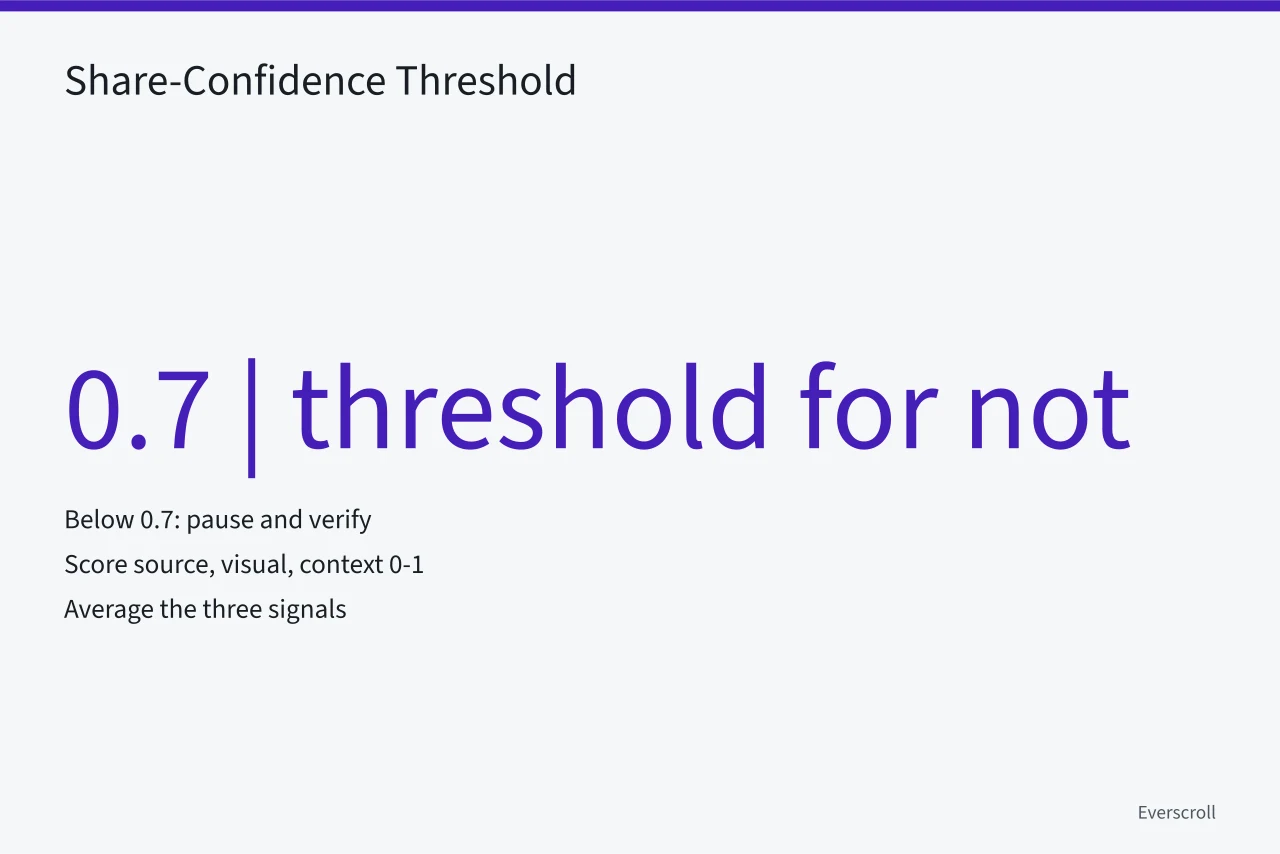
The metric here is a share-confidence score. You assign it after checking an image for three signals: who published it, whether visual details hold up, and what metadata or context accompanies it. Score each signal from 0 to 1, then average them. A score below 0.7 is your threshold for not sharing and for labeling the image as suspected synthetic. This is not a detection tool. It is a personal gate you apply before a share.
California law AB 730 limits distribution of deceptive audio or visual media about candidates within 60 days of an election. Texas SB 751 creates a criminal offense for deepfake videos intended to injure a candidate or influence an election within 30 days. The deepfake article tracks how these laws are developing. The California privacy rules article explains how state privacy law applies to your online community. For US users, sharing a politically targeted fake can carry legal risk even if you did not create it. Your feed is not neutral ground.
How to read the score
A share-confidence score works only when you score the same three signals each time. Source means asking whether the account has a verifiable history. Visual means looking for the artifacts described below. Context means checking reverse image search results or a news report. If any signal scores below 0.5, treat the image as suspect regardless of the average.
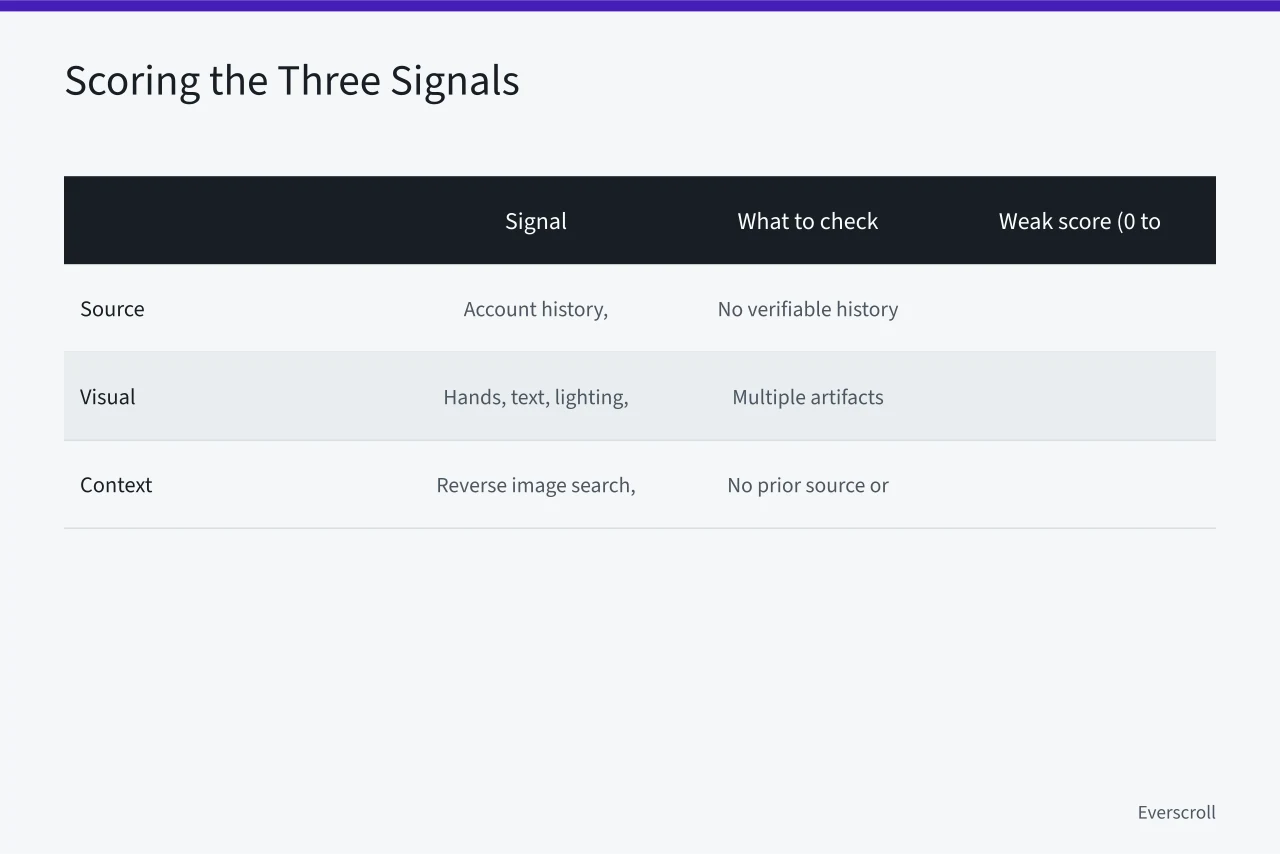
| Signal | What to check | Weak score (0 to 0.4) |
|---|---|---|
| Source | Account history, original poster | No verifiable history |
| Visual | Hands, text, lighting, edges | Multiple artifacts visible |
| Context | Reverse image search, fact-checks | No prior source or contradictory reports |
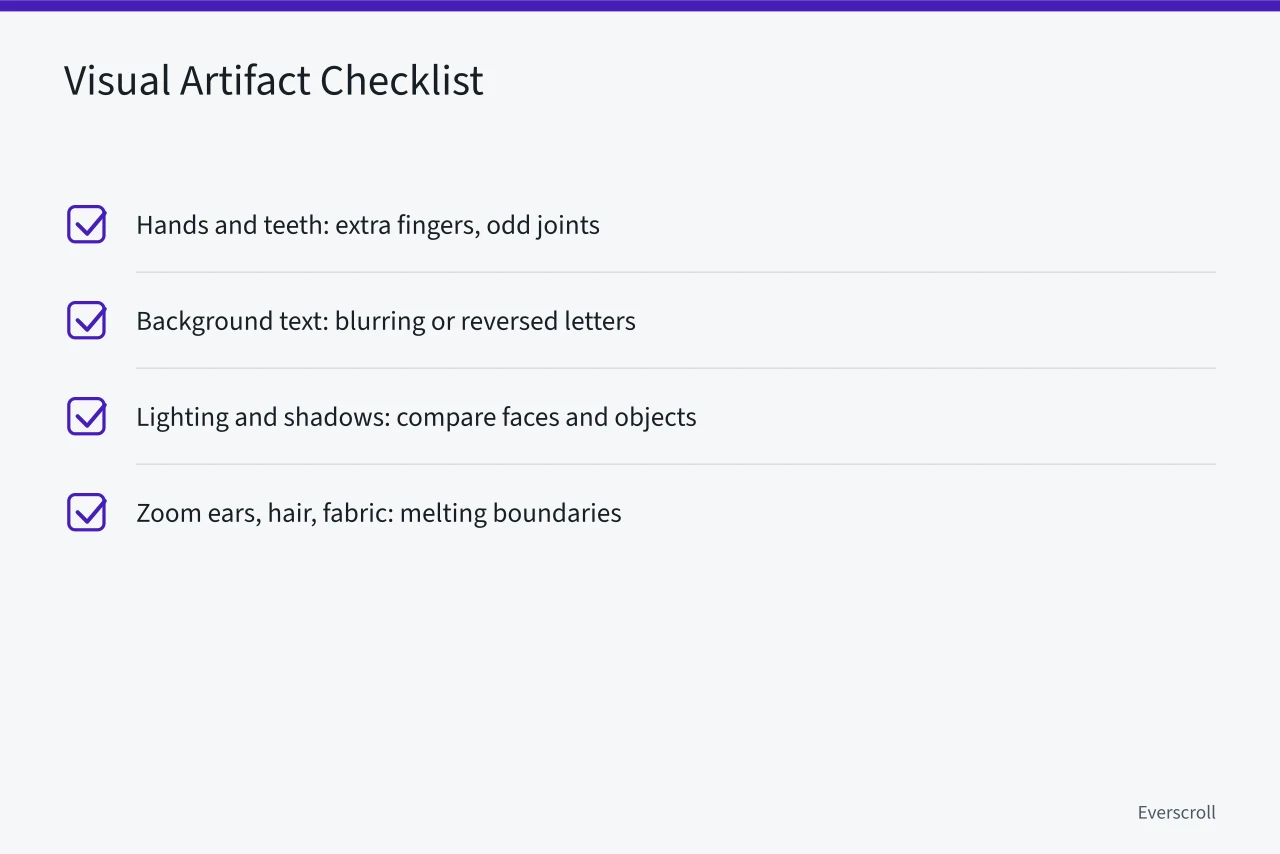
Use this checklist for the visual part.
- Look at hands and teeth for extra fingers or oddly shaped joints.
- Check background text for letters that blur or reverse.
- Compare lighting and shadows across faces and objects.
- Zoom on ears, hair, and fabric edges for melting boundaries.
The artificial intelligence art article documents common artifacts in synthetic images. These tells change as models improve. Do not rely on them alone.
What the score cannot tell you
A share-confidence score measures your own judgment, not ground truth. It cannot tell you whether an image was generated by a specific model or edited by a human. It cannot detect a fully generated image that has no visible artifacts and comes from a credible-looking source. Some synthetic images pass every visual check. Your score can be above 0.7 while the image is still fake.
The NIST AI Risk Management Framework treats synthetic media verification as a risk decision, not a single detection event. It notes that no automated detector is perfect. Your score inherits that limit. A high score only means you saw enough consistent signals. It does not mean the image is real.
Attribution and its limits
Attribution means tracing an image to a person, outlet, or event. You can use reverse image search and public databases. Attribution works best for images that have been previously fact-checked. It fails for images that are new, private, or spread first in closed groups. A source account can be stolen or bought, so a familiar name is not proof. When you cannot find an original source, set your confidence score to 0.4 or lower.
Section 230 limits most platform liability for user posts in the US. That means Section 230 explained matters when you ask why a platform leaves a fake image up. The law does not make you immune from state deepfake rules. Your sharing decision remains yours.
When to stop measuring and decide
Stop scoring when you have checked all three signals once and still have a clear result. If your score is below 0.7, do not share and report the image using the platform's synthetic media label. If your score is 0.7 or above but source or context is weak, wait for a fact-check. Do not keep re-scoring an image to talk yourself into sharing it.
Washington, D.C. shapes US platform rules through the FTC and FCC. That includes disclosure requirements for ads and deepfake rules. Federal actions change platform duties over time. Your sharing choice feeds the next round of synthetic media. Stopping to measure is enough when you have made a defensible call.
Common questions
Is the share-confidence score a real test? No. It is a personal rubric for slowing down a share. It does not replace reverse image search or a fact-check.
What should I do if my score is exactly 0.7? Treat 0.7 as the threshold, not a pass. Check source and context again. If either is below 0.5, do not share.
Do California and Texas laws apply to me if I live elsewhere? They can apply if you share synthetic media about a candidate in those states or if your post reaches voters there. Check current law before relying on this summary.
Can I trust a platform label that says "AI-generated"? Platform labels are helpful but not complete. Use them as one signal, not the final word. A missing label does not mean an image is real. If you share an AI-generated image in a paid post, the FTC endorsement guides article details the disclosure rule.