

Features
Part of Online trends and virality: a guide to signals, spread, and context
Viral rumor response case: from signal detection to correction
Viral rumor response case showing how a fictional public agency detects a signal, verifies the claim, assesses harm, writes a correction, and measures the response.
What to take away
- This fictional case demonstrates a method and does not describe a real emergency.
- The response team separates the circulating claim from audience questions and measurable harm.
- Verification happens before public rebuttal.
- The correction leads with the confirmed action people should take.
- Success is measured through behavior and repeated questions, not correction views alone.
This case follows the fictional Riverton Water Office after a short video claims that the city's tap water has been declared unsafe. All names, posts, figures, and events are invented. The case does not provide drinking-water or emergency advice.
At 8:20 a.m., a customer-service worker notices seven calls repeating the same claim. A public video posted the prior evening has 46,000 views and shows cloudy water running from one faucet. The caption says a citywide warning was hidden from residents.
1. Define the signal
The team records the exact claim: "The city issued but concealed a citywide do-not-drink notice." It saves the public URL, caption, upload time, visible footage, and call summaries. It does not download or publish the poster's private details. The record follows the checklist rule to preserve before searching: exact wording, context, and displayed time first.
Preserve the claim first
- Exact wording of the claim
- Public URL and caption
- Upload time and displayed time
- Visible footage
- Call summaries
- No private poster details
The team separates three questions:
Define the signal
- Was any citywide notice issued?
- Is there evidence of a system-wide water problem?
- What caused the cloudy water shown in this home?
Only the first two can be checked immediately through office records and current system data. The third requires information about a specific property and cannot be answered from a video.
2. Verify
The duty manager checks the alert log, laboratory results, pressure alarms, maintenance record, and messages sent by the authorized notification system. No citywide notice exists. Current readings remain within the office's stated operating thresholds, but one localized repair occurred the prior afternoon.
The team calls the public health contact and utility field supervisor through established numbers. Both confirm the record. Staff avoid claiming that the pictured faucet is safe because they have not inspected it. The established-number call is the recurring hero of these cases; the commission impersonation save turned on the same move.
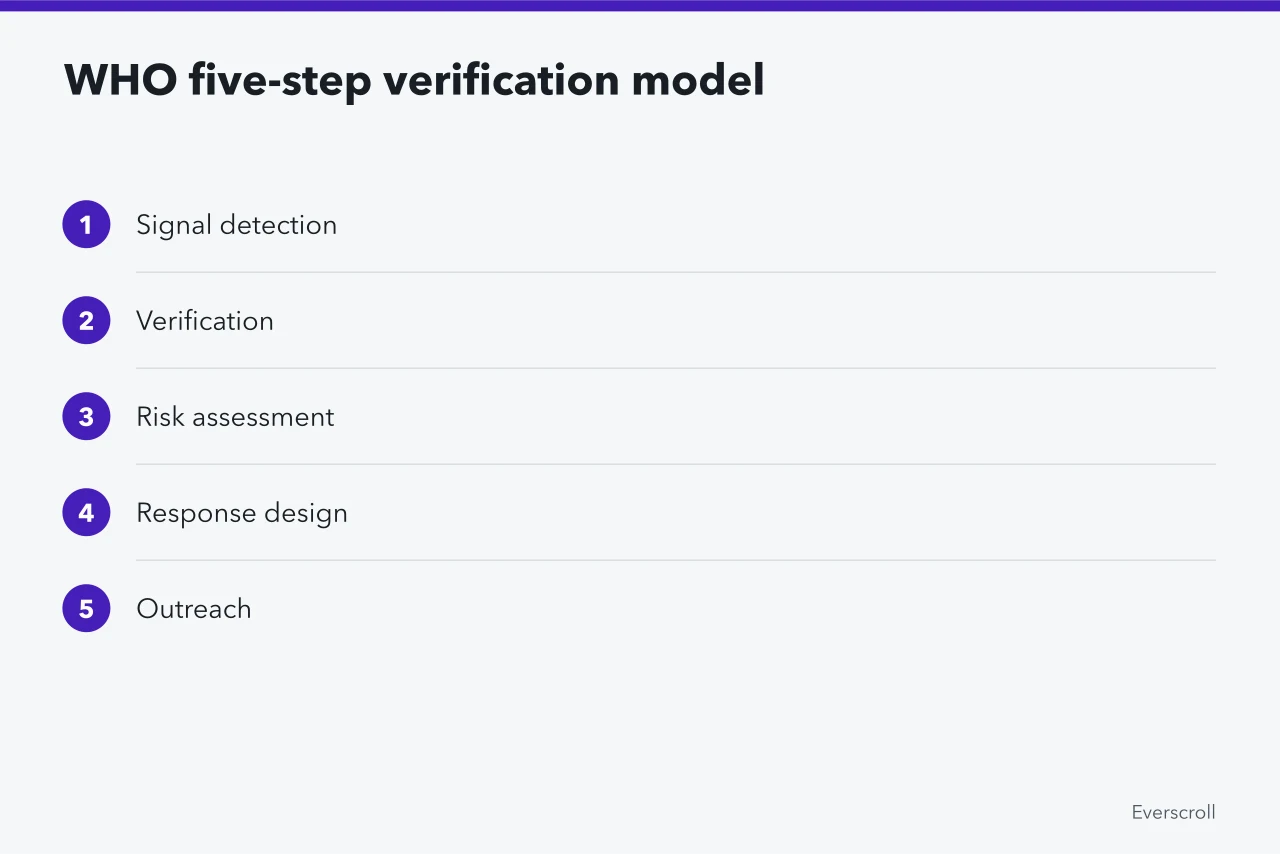
The World Health Organization's operational toolkit for false information in health emergencies describes a five-step process of signal detection, verification, risk assessment, response design, and outreach. Riverton uses that sequence as an organizing model, while this fictional water event is not a claim that the WHO document governs a local utility.
3. Assess harm and information need
The false notice claim could cause people to avoid water unnecessarily, buy scarce supplies, overwhelm call lines, or miss future real instructions. The video also reveals a valid question: what should a resident do when water looks cloudy after nearby work?
Harm vs. information need
Potential harm
- Water
- Avoid water
- Supplies
- Buy scarce supplies
- Calls
- Overwhelm call lines
- Instructions
- Miss real instructions
Valid question
- Water
- Cloudy after work
- Supplies
- What to do
- Calls
- Service number
- Instructions
- Check address
The team rates the response as urgent but not an emergency alert. It chooses the channels residents already use for service notices and prepares a short call script for staff.
4. Design the response
The first draft begins, "A viral video falsely claims..." The editor changes it because repeating the allegation first may give it more reach. The rewrite avoids the amplification trap: a correction that leads with the false claim carries it further. The final notice begins with the confirmed action:
"No citywide do-not-drink notice is in effect as of 10:15 a.m. on December 29. Current notices are listed on the city alert page and sent through the official notification system. If your water appears cloudy after local work, use the service number below so staff can check your address."
The longer note explains which records were checked, gives the timestamp, distinguishes a local repair from a citywide notice, and promises an update at 2 p.m. It does not name the original poster.
5. Publish and reach people
The office posts the notice on its specific alert page, text system, recorded phone line, and verified social accounts. Customer-service staff receive the same wording and a route for property-specific reports. Neighborhood partners get a plain-language version and translations used by the city.
FEMA's release about its Hurricane Helene rumor response page explains that disaster rumors can spread through social media and word of mouth, and that FEMA used a dedicated page to confirm facts and explain assistance. Riverton borrows the idea of a stable, official correction location, not the facts or scale of that disaster response.
6. Measure the response
The team watches four measures from 10:15 a.m. to 6 p.m.:
Measure the response
| Measure | Before notice | After notice | Interpretation |
|---|---|---|---|
| Calls repeating concealed-notice claim | 7 per hour | 1 per hour | Repetition fell |
| Address-specific cloudy-water reports | 1 | 14 | Correct reporting route became clearer |
| Visits to official alert page | 180 | 6,400 | Confirmed information reached more users |
| Original video views | 46,000 | 61,000 | False item still circulated |
These figures are fictional. The office does not call the response successful merely because its post gained views. Fewer repeated rumor calls and more address-specific reports are closer to the operational goal.
7. Close and document
At 2 p.m., the office posts the promised update; field staff identify ordinary air in plumbing after the localized repair at several reported addresses. The office still handles each unresolved report on its facts.
The alert page keeps the correction time, evidence reviewed, updates, and contact route. The promised update time gives residents an endpoint for repeated checking; refresh loops feed on open questions.
The after-action record notes one weakness: service-call patterns found the rumor before the communications monitor did. The office adds a shared signal log between customer service, field operations, public health, and communications.
What the case shows
The response did not debate motive, shame the poster, or claim more than the records showed. It verified the defined claim, addressed the underlying question, gave an action, used a stable source, and measured whether public behavior moved toward the correct route.
Common questions
Is Riverton a real city?
No. The city, office, incident, posts, and figures are fictional.
Why did the office avoid naming the poster?
Identity was unnecessary to correct the public claim and could have increased harassment or reach.
Why not say the pictured water was safe?
The team had not inspected that property and could only confirm system records and official notices.
Why publish a promised update time?
It tells residents when to expect new information and gives the office a clear review point.
Did rising views on the original video mean the correction failed?
Not by itself. The response tracked call content and use of the correct reporting channel as well.
What changed after the case?
The fictional office created a shared signal log so service, field, health, and communications staff could identify repeated claims earlier.