Reviews
Digital nomad hubs compared: Austin, Miami, and Denver for US creators
Ever scroll through US digital nomad hubs: Austin, Miami, and Denver compared on rent, coworking, broadband access, and creator meetups for US creators.
What to take away
- If you ever scroll through options for a US creator base, Austin, Miami, and Denver each trade rent against network, climate, and access in different ways.
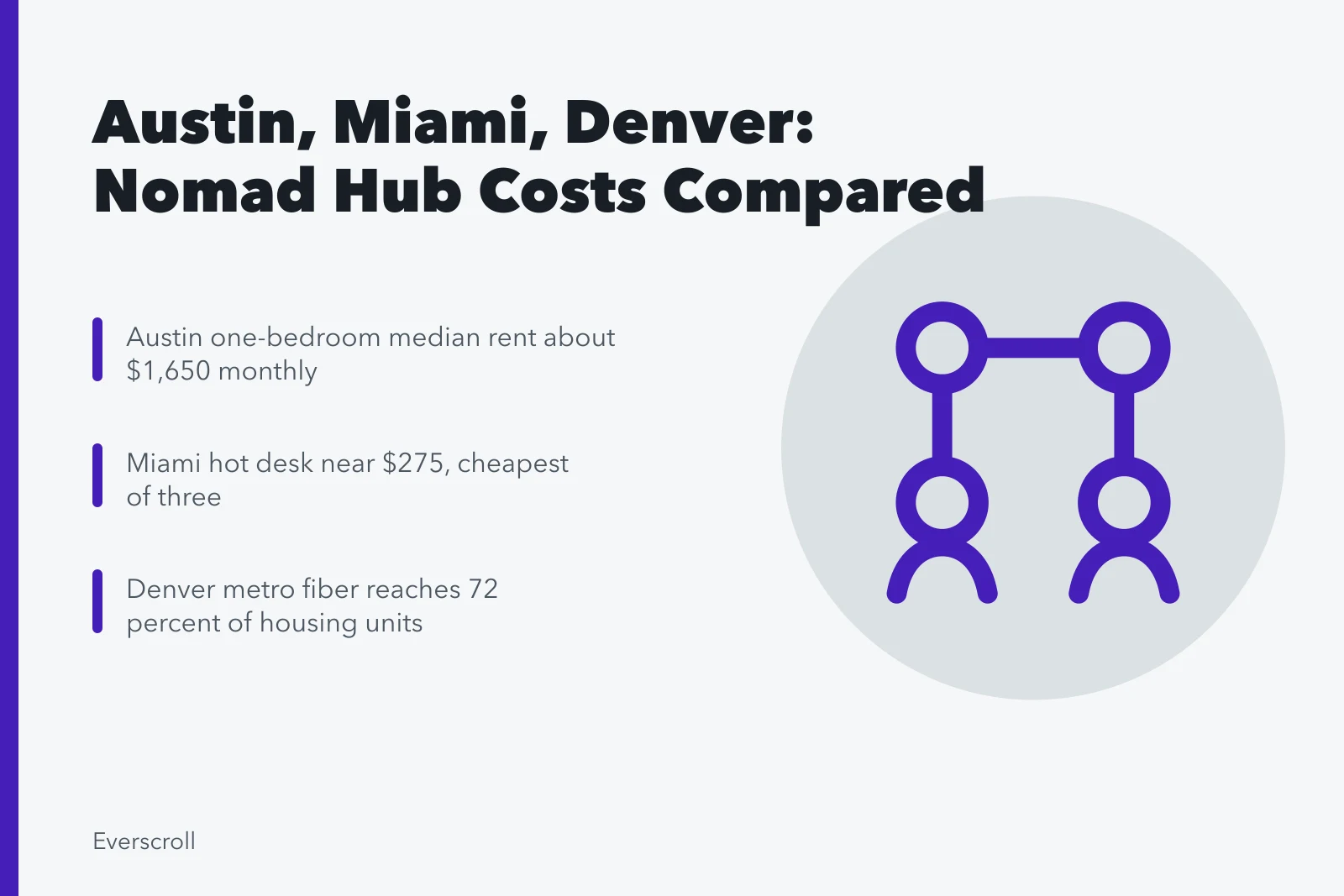
- Austin's core one-bedrooms run about $1,650 a month, above Denver's roughly $1,600 and below Miami's beachside $2,600.
- Miami has the cheapest hot desks of the three, near $275, and the weakest suburban broadband.
- Denver leads on metro fiber coverage and keeps coworking near $300 a month.
- Named spaces matter more than city averages: Capital Factory, The LAB Miami, and Industry RiNo Station anchor each scene.
Rent and cost of living across Austin, Miami, and Denver
Austin's median one-bedroom rents for about $1,650 a month. East Austin and Mueller push past $1,900, while older duplexes near Hyde Park sit closer to $1,400. Denver's median is near $1,600, with Capitol Hill around $1,450, RiNo around $1,800, and Aurora under $1,400.
Miami spreads widest: Brickell and South Beach one-bedrooms clear $2,600, while Little Havana, Hialeah, and Doral average $1,700 to $1,900.
Use the Overview of BLS Statistics by Geography to pull regional price and wage context before you sign a lease. Area-level consumer price and employment data let you compare a metro's cost structure against national averages instead of one listing.
That context matters more than a headline rent figure because it captures food, transport, and services alongside housing.
A solo video creator grossing $95,000 from ads and sponsors keeps roughly $8,000 more a year in Denver than in Austin after rent and utilities at the same apartment size. In Miami the gap narrows to about $3,000 once insurance and cooling costs are counted.
Your digital communities comparison should price those regional costs before you commit to a lease.
Austin's rent buys proximity to production talent. Miami's buys climate and a Latin American media corridor. Denver's buys space and outdoor shooting locations within an hour of downtown.
Coworking and studio costs for creators in each city
Named spaces with published list prices beat city averages for planning. In Austin, a hot desk at Capital Factory runs about $350 a month, Vuka about $250, and private studios at Springdale General $600 to $1,200. The Austin Central Library's recording and editing rooms are free with a library card.
In Miami, The LAB Miami in Wynwood charges about $275 for a hot desk and Pipeline Workspaces in Brickell about $400. Bakehouse Art Complex studio space runs $450 to $900 a month and Mana Contemporary runs $500 to $1,200, both with waitlists.
Denver listings: Industry RiNo Station near $300, The Yard $325, Converge Denver $250, and the Denver Media Center rents a sound-treated room for about $50 an hour.
| City | Named space | Type | Rate |
|---|---|---|---|
| Austin | Capital Factory | Hot desk | $350 per month |
| Austin | Springdale General | Private studio | $600 to $1,200 per month |
| Miami | The LAB Miami | Hot desk | $275 per month |
| Miami | Bakehouse Art Complex | Studio | $450 to $900 per month |
| Denver | Industry RiNo Station | Hot desk | $300 per month |
| Denver | Denver Media Center | Sound room | $50 per hour |
Rates are published list prices and move with lease terms, so treat them as opening numbers for negotiation. The wider digital communities checklist covers how fixed costs like these sit against variable income.
Broadband access and speed comparisons by metro
The National Broadband Map puts fiber availability at roughly 72 percent of housing units in the Denver metro, 58 percent in the Austin metro, and 46 percent in Miami-Dade County. Where fiber exists, advertised residential tiers reach 1 gigabit or more. Cable upload speeds in the same areas typically cap near 35 Mbps.
Check the National Broadband Map block by block before you commit to an address. It shows provider, technology type, and advertised speed down to the census block, the only reliable way to confirm fiber in a specific apartment building.
Roughly eight in ten US adults have home broadband, and the Demographics of Internet and Home Broadband Usage in the United States | Pew Research Center tracks the gaps that persist. Upload capacity, not download speed, decides whether you deliver client work on deadline.
Denver leads on suburban fiber. Austin is strong in the core and patchy at the edges. Miami's beachside and inland coverage diverge most, and older buildings still cap uploads well below video delivery needs. Mobile fallback is not a substitute, since one 4K upload can exhaust a hotspot plan and the map does not capture peak-hour congestion.
Creator meetups and named local spaces in Austin
Active Meetup listings in Austin include Austin Podcasters, Austin Video Creators, and Content Creators Austin. The groups meet monthly at Capital Factory, Vuka, and the Austin Central Library. Capital Factory sessions cover publishing and audience growth. Vuka hosts networking nights. The library runs free editing workshops.
Austin's tech and music overlap produces more cross-discipline events than Miami or Denver, which helps creators who work across formats. If you are building a digital communities example, that density shortens the time between an idea and paid work.
Summer heat pushes meetups indoors and slows outdoor shooting. The festival calendar concentrates opportunity into a few intense weeks, so plan production around those peaks rather than against them.
Creator meetups and named local spaces in Miami and Denver
Miami listings include Miami Creators Meetup, South Florida Video Producers, and Miami Podcasters. They meet at The LAB Miami, Pipeline Workspaces, and the Idea Center at Miami Dade College. Mana Contemporary and Bakehouse Art Complex host studio and exhibition nights. Programming leans bilingual and brand focused.
Denver listings include Denver Creators, Denver Podcasters, and Colorado Outdoor Content Creators. They meet at Industry RiNo Station, The Yard, and Converge Denver, while the Denver Media Center runs production workshops. Mountain access gives outdoor creators a logistical edge that neither Austin nor Miami matches.
Both cities run smaller, more focused calendars than Austin. Fewer events, less competition for attention when you host your own.
Which hub fits which kind of creator work
Match the hub to the work. Austin suits video, music, and independent media creators who need collaborators and will pay $1,650 rents for that density. Miami suits brand, lifestyle, and bilingual creators who can work around 35 Mbps uploads in exchange for $275 desks.
Denver suits software, outdoor, and podcast creators who want fiber and space near $1,600.
A checklist for the decision:
- Confirm fiber upload speed at the exact address.
- Price a year of rent plus coworking in each city.
- Check Meetup listings for your format.
- Book a studio hour before committing.
- Model state taxes and insurance.
- Visit in the worst season, not the best.
Creators also face digital communities problems regardless of city, so a hub choice should cut costs and friction rather than promise stability. The Pew Research Center's ongoing Internet & Technology - Research and data from Pew Research Center work tracks how remote and online work keeps shifting, which is worth reading before a long lease.
Common questions
Which city is cheapest for a creator starting out? Denver, on the numbers here: roughly $1,600 rent and $300 hot desks, against $1,650 and $350 in Austin. Miami's $275 desks are the cheapest single line item, but insurance and cooling add back several thousand a year.
Where is broadband best for upload-heavy work? Denver leads at about 72 percent fiber availability across the metro, against 58 percent in Austin and 46 percent in Miami-Dade. Always verify the specific building on the National Broadband Map.
Which city has the best creator meetups? Austin has the densest and most cross-discipline calendar, Miami has the strongest bilingual and brand programming, and Denver has the most focused outdoor and software groups.
Do I need to register my business in the city I move to? Yes. Most creators need a local business registration and should review state tax rules, since self-employment tax and 1099 reporting follow federal rules but state and local requirements differ.
How much should I budget for coworking and studio time? Plan on roughly $250 to $400 a month for a hot desk, $450 to $1,200 for dedicated studio space, and hourly rates near $50 where you only need a sound room occasionally.